

Workflow guides
Should you build or buy customer follow-up automation?
Evaluate one complete workflow, assign operational responsibilities, test failure cases, and compare the full cost of maintaining each option.
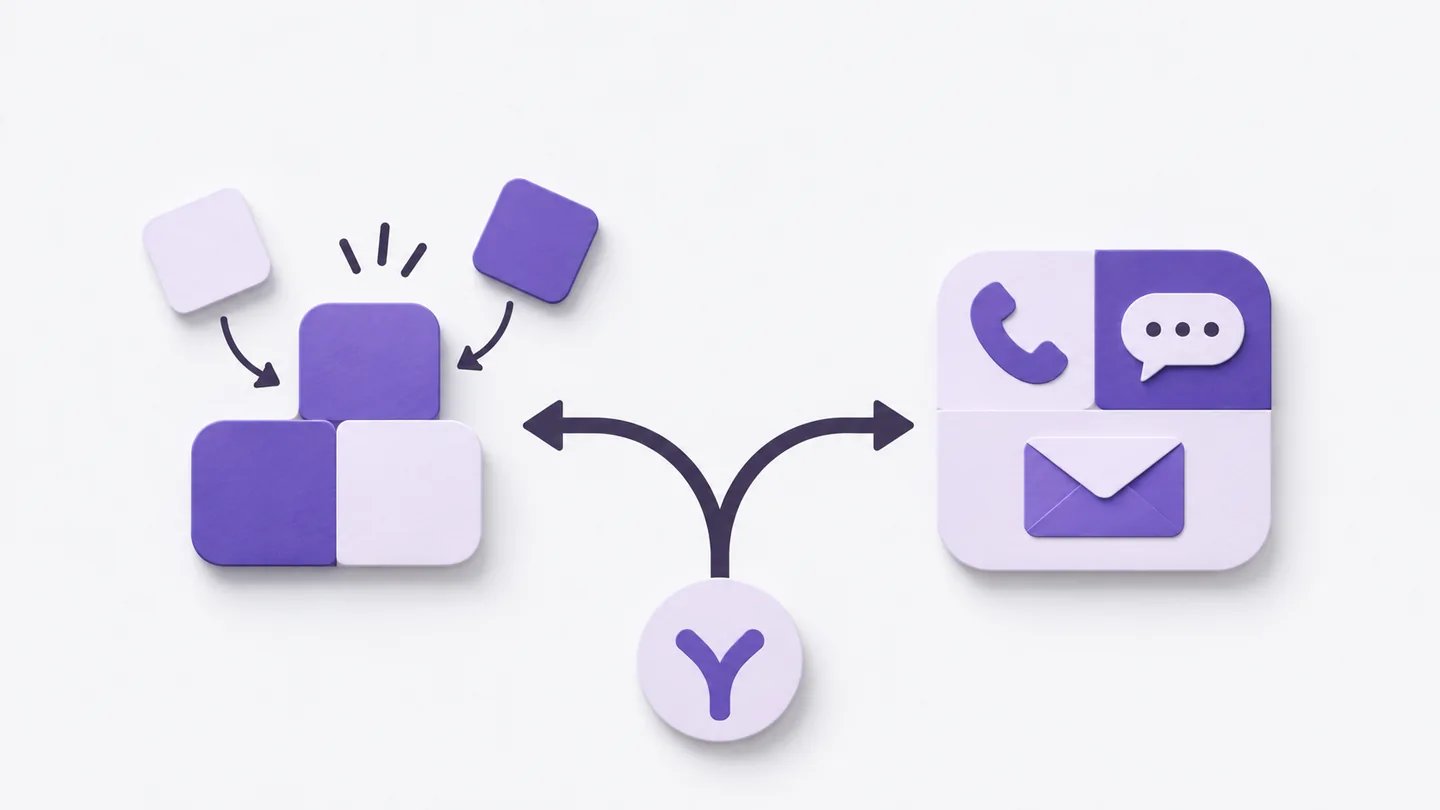
Build customer follow-up in-house when the required behavior is narrow, your team can operate it reliably, and owning that behavior is worth the maintenance. Evaluate a platform when coordination across channels, replies, business events, and staff recovery is becoming a system your product team must continually support.
The useful comparison is the complete workflow your team will own. “Can we send a text?” is a different question from “Can we explain and safely recover a customer's follow-up after a timeout, a reply, and a scheduling change?”
Begin with a concrete workflow
Write a small acceptance scenario before comparing products. For example: an authorized service inquiry arrives, a text asks for a callback preference, an unanswered inquiry may receive a later call, and a confirmed booking ends the remaining outreach. A request for a person creates a task in the CRM.
Include the business key, the contact permissions, the source of the booking event, the staff owner, and the exact CRM operation. A connector name is not an acceptance test. The account needs access to the relevant object, trigger, and write operation.
Use the same scenario for an internal implementation and a vendor evaluation. Otherwise, the internal estimate often covers the first send while the vendor is being judged on the whole production process.
Know when a small build is enough
A single transactional notification with one provider, one template, and an existing background-job system may fit comfortably in your application. You still need appropriate permissions, error handling, and operational visibility, but a separate orchestration layer may offer little additional value.
The scope changes when a later attempt depends on a reply from another channel, a business event outside the messaging provider, or a human decision. Now the system must hold state over time and distinguish “try later” from “do not contact again.”
Keep the build option honest in both directions. Your team may already own useful infrastructure, but inherited infrastructure still has limits, failure modes, and an on-call owner.
Assign the responsibilities before pricing them
For each responsibility, name the owner and the evidence that it works:
- Eligibility and consent: who decides this customer may receive this message for this purpose?
- Start deduplication: what happens if the initiating request is repeated after a timeout?
- Channel configuration: who maintains agents, senders, phone routing, templates, and provider credentials?
- State and stopping: how do replies, opt-outs, bookings, deadlines, and changed orders affect later attempts?
- External updates: who verifies that the CRM task, booking, or order update succeeded?
- Operational recovery: how does staff investigate an uncertain attempt without creating a duplicate contact?
- Security and data handling: who controls access, validates callbacks, limits retained data, and reviews the services involved?
- Change management: what evidence explains which instructions and configuration a historical run used?
A vendor's feature list should lead to a demonstration of these responsibilities, not replace one.
Evaluate failure cases as well as the first send
Use synthetic records and destinations you control. Check five cases that expose the ownership boundary:
- The start response is lost. Repeat the same intent and verify that it resolves to the same run. A provider timeout later in the workflow is a separate problem.
- A reply arrives during a wait. Confirm that the configured rule affects the next attempt and that any staff handoff is usable.
- A business record changes elsewhere. Verify that the correct inquiry or order is matched, including when one contact has several open requests.
- A connected-app action fails. Recover the record update without starting unnecessary customer outreach again.
- An operator changes the workflow. Check what happens to an active run and what evidence remains available afterward. Do not infer version behavior from the editor's current appearance.
Ask the person who would handle an incident to find the answer in the actual tools. If the explanation requires an engineer to reconstruct several databases, include that cost in the decision.
Compare costs using your own workload
Use the same time horizon for both options. For an internal build, include implementation, security review, monitoring, storage, support tooling, provider changes, and expected maintenance. Price engineering time using your team's actual fully loaded cost, not only the initial development ticket.
For a platform, include subscription or usage fees, provider charges, integration work, ongoing configuration, support, and any migration or exit work. Count inbound and outbound usage, multi-segment texts, call duration, and connected-app activity when they apply. Avoid comparing a platform's total bill with only the internal system's messaging bill.
Model a normal month and a high-volume month. State which values are measured, which are estimates, and which are excluded. Use Tremi's current pricing for its current units and allowances rather than copying a rate into a long-lived spreadsheet without a review date.
Where Tremi fits
Tremi provides a workspace for configured customer follow-up across calls, texts, email, and supported connected-app actions. Your team still chooses the business purpose, the approved inputs, the completion condition, and the people responsible for exceptions. Provider accounts and integration permissions still need to be configured for the actual use case.
An API start can give product code a defined entry point into that workflow. It does not establish a universal guarantee about provider delivery, booking, or arbitrary system access. Confirm those outcomes with the selected providers and destination systems.
Tremi is worth evaluating when your team wants to configure and operate these workflows without building all of the coordination and staff tooling itself. Building may remain preferable when the behavior is a core product capability, the integration requirements are unusually specialized, or the existing internal system already meets the acceptance cases economically.
Make the decision reversible where possible
Keep business identifiers and authoritative outcomes in systems your team can access. Document the field mappings, provider ownership, export needs, and how active work would be drained or transferred during a change. Review data-retention and access requirements before committing a sensitive workflow.
Finish the evaluation with a short decision record: the workflow tested, cases passed, gaps, total-cost assumptions, and named owners. Use the integration catalog to verify channel and app fit, and the follow-up measurement guide to define what a successful pilot must demonstrate.